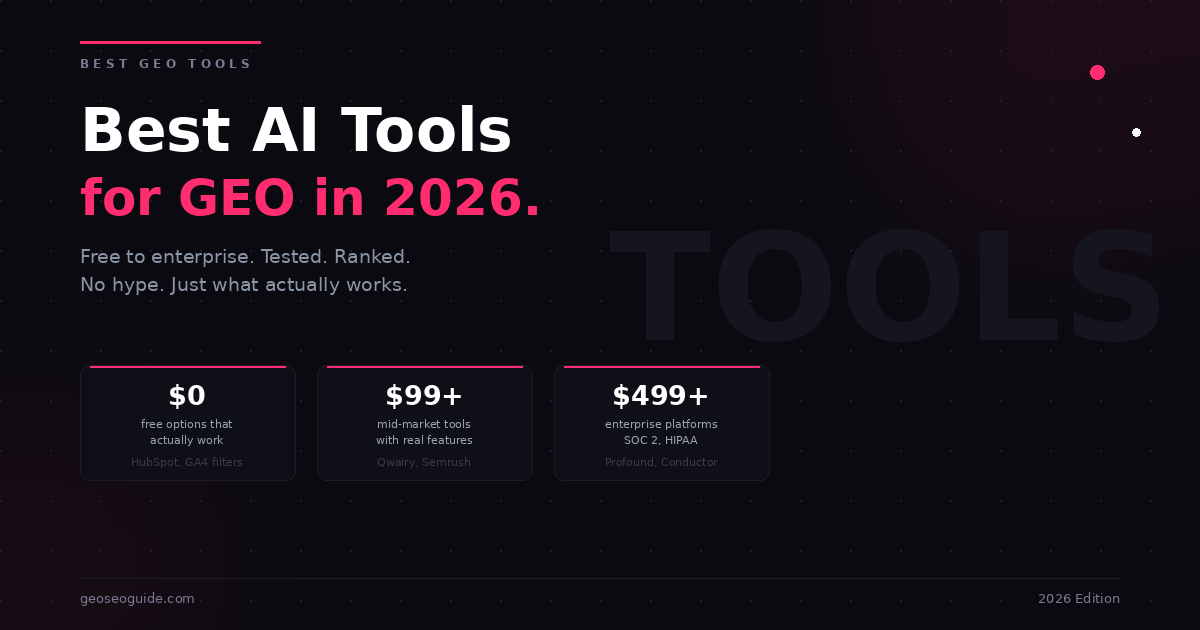
The Best AI Tools for Generative Engine Optimization in 2026. Tested. Ranked. No Hype.
From free to enterprise. From monitoring to full optimization. Here are the GEO tools that actually move the needle — what they do, what they cost, and who they’re for.
The GEO tool market exploded in 2025. What started as a handful of monitoring scripts has become a $7.3 billion category projected by 2031, with dozens of platforms claiming to track, audit, and optimize for AI search visibility. The problem isn’t finding tools — it’s figuring out which ones actually work, and which ones are vaporware wrapped in clever marketing.
I’ve spent the past few months evaluating the leading GEO platforms across pricing, AI engine coverage, monitoring depth, and actionability. This guide is the honest breakdown — organized by budget and use case so you can pick the right tool for where you are right now, not where someone wants to sell you.
One quick note before we dive in: no GEO tool can guarantee you’ll appear in AI responses. As Geoptie’s tool comparison puts it, AI responses are non-deterministic — they vary based on prompts, context, and model updates. What good tools do is help you understand what content gets cited, identify gaps, and optimize to increase citation probability over time. Anyone promising guaranteed results is selling something you shouldn’t buy.
Free Tools: Start Here If You’re Just Exploring GEO
You don’t need to spend money to start measuring AI visibility. Several legitimate free options exist — and they’re more than good enough for an initial baseline.
HubSpot AI Search Grader
HubSpot’s AI Search Grader is completely free and provides a quick assessment of how your brand appears across ChatGPT, Perplexity, and Gemini. It evaluates mention frequency, sentiment, and competitive positioning. No commitment required, no credit card. According to Geoptie’s review, it’s “completely free; quick assessment; no commitment required” — making it the best zero-cost starting point.
Best for: Marketers running an initial AI visibility audit. Anyone who wants a quick reality check before committing budget.
Manual Prompt Testing + Spreadsheet
The most underrated free method: pick 20–30 prompts your audience would actually ask, run them across ChatGPT, Perplexity, and Google AI Mode, log the results in a spreadsheet, and repeat weekly. This is exactly what dedicated GEO tools do at scale — you can do it manually for your top queries before paying for automation.
GA4 Regex Filters
Set up regex filters in Google Analytics 4 to isolate AI referral traffic. Filter referral sources matching chatgpt|perplexity|gemini|claude|copilot|openai. This costs nothing and gives you a clean baseline for AI traffic separately from organic. Recommended by Seer Interactive as the foundation of any GEO measurement program.
Entry-Level Paid Tools ($25–79/month)
Otterly.AI
Otterly.AI made GEO monitoring accessible with an entry plan starting at $29/month. According to multiple tool comparisons, it tracks brand mentions and citations across six AI engines with automated weekly reports. The GEO audit tool analyzes 25+ on-page factors, and there’s a Semrush App Center integration for teams already using Semrush.
Pricing: Lite $29/mo (10 prompts), Standard $189/mo (100 prompts), Pro $989/mo (1,000 prompts).
Pros: Affordable entry point, 14-day free trial, Gartner Cool Vendor 2025, simple setup.
Cons: Lite plan is limited to ~10 prompts; costs scale significantly with volume.
Best for: Small teams testing GEO on a budget.
Rankscale
Rankscale starts at $20/month, making it one of the most affordable entries in the GEO space. It focuses on prompt-level brand mention tracking with simple dashboards. Light on features compared to enterprise tools, but solid for early-stage monitoring.
Peec AI
Peec AI offers AI brand visibility analysis starting around €89/month (~$99). It specializes in detailed breakdowns of how brands appear in AI responses, with strong competitor benchmarking. Good middle ground between pure monitoring and full optimization.
Mid-Market Tools ($99–399/month)
This is where most teams find the sweet spot. Real features, actionable recommendations, and pricing that doesn’t require executive sign-off.
Qwairy
Qwairy is one of the most advanced platforms in the mid-market range. It tracks mentions across ChatGPT, Perplexity, Gemini, Google AI Overview, Google AI Mode, Microsoft Copilot, and Grok. According to Qwairy’s own tool comparison, the platform combines AI visibility monitoring, strategy dashboards with prioritized action items, technical SEO audits (robots.txt, llms.txt), and conversational query discovery.
Pros: Broad AI provider coverage at every plan tier, full-stack approach (monitoring + optimization), MCP capabilities.
Best for: Mid-market teams that want one tool covering both monitoring and optimization workflows.
Semrush AI Toolkit
If you’re already paying for Semrush, the AI Toolkit add-on at $99/month is the path of least resistance. It integrates AI visibility tracking directly into the Semrush workflow most SEOs already use. According to Averi’s tool review, it tracks brand visibility across major AI platforms with the data integration benefits of Semrush’s broader SEO ecosystem.
Best for: Teams already on Semrush who want to add GEO without context-switching to a new platform.
Ahrefs Brand Radar
Similar story for Ahrefs users. Brand Radar tracks AI mentions and integrates with Ahrefs’ existing keyword and backlink data. Best for teams that need to correlate AI visibility with traditional SEO performance.
Profound Starter / Growth
Profound’s entry tier starts at $99/month for ChatGPT-only tracking with 50 prompts and email support. The Growth plan at $399/month covers 3 answer engines, 100 prompts, and 6 optimized articles per month. According to AI Clicks’ review, this is where Profound becomes interesting for mid-market teams who don’t need enterprise features.
Scrunch
Scrunch operates differently from prompt-trackers. According to Scrunch’s own platform overview, it covers monitoring, auditing, optimization, and content delivery via their Agent Experience Platform — automatically delivering AI-optimized content directly to LLMs. Plans: Core $250/mo, Enterprise custom.
Enterprise Platforms ($499+/month)
Profound
Profound is the market leader for enterprise AI visibility, backed by $35M Series B from Sequoia Capital. The platform monitors 10+ AI engines including ChatGPT (with GPT-5.2 support), Claude, Perplexity, Google AI Overviews, Gemini, Copilot, DeepSeek, and Grok. What sets Profound apart according to their own platform docs is the three-dimensional data approach: AI results data, 400M+ real user prompts via Conversation Explorer, and AI crawler analytics.
Pricing: Lite from $499/month; Agency Growth at $1,499/month; Enterprise custom.
Pros: SOC 2 Type II and HIPAA compliance, dedicated AI strategist support, G2 Winter 2026 AEO Leader, deepest enterprise feature set.
Cons: Expensive, no free trial, requires sales process.
Best for: Enterprise organizations, regulated industries (healthcare, pharma, finance), and agencies needing defensible AI visibility data.
Conductor AI
Conductor was founded in 2010 as an SEO platform and expanded into GEO in 2025. According to Scrunch’s tool review, Conductor AI combines traditional SEO intelligence with AI search visibility insights — particularly valuable for teams that want to connect AI visibility data with broader content workflows. Plans range from $59 to $499/month based on prompt volume.
Adobe LLM Optimizer
Adobe entered the GEO market in October 2025 with LLM Optimizer, an end-to-end tool for enterprise companies already using Adobe Experience Cloud. Best for organizations already invested in the Adobe stack.
AthenaHQ
AthenaHQ provides enterprise-grade benchmarking with deep AI visibility scoring, prompt volume tracking, action center recommendations, and a Shopify integration for ecommerce attribution. According to SE Visible’s review, AthenaHQ stands out for competitive benchmarking and source intelligence — showing which third-party websites influence AI answers about your category.
Best GEO Tools for E-Commerce Specifically
E-commerce has its own GEO subspecialty. AI shopping assistants like Amazon Rufus, ChatGPT Shopping, and Perplexity’s product recommendations need different optimization signals than B2B SaaS content.
Azoma
According to Ecomtent’s ecommerce GEO comparison, Azoma is the strongest end-to-end GEO platform for e-commerce. Features include enterprise-grade accuracy, deep marketplace integrations, and measurable commercial impact. Built specifically for product-level optimization, not just brand mention tracking.
Profound’s Shopping Analysis
Profound launched a Shopping Analysis feature specifically for AI-driven retail discovery. It captures product images, placement within conversations, competitive comparisons, and the attributes AI assigns to products — providing retailers visibility into the new purchase funnel that’s replacing traditional website browsing.
How to Choose the Right GEO Tool for You
- HubSpot AI Search Grader (free)
- Manual prompts in spreadsheet
- GA4 regex filters for AI traffic
- Goal: establish a baseline
- Qwairy or Semrush AI Toolkit
- Otterly.AI Standard
- Profound Starter / Growth
- Goal: automated tracking + actions
- Profound (SOC 2, HIPAA)
- Conductor AI / Adobe LLM Optimizer
- AthenaHQ for benchmarking
- Goal: defensible enterprise data
When evaluating any GEO tool, ask five questions:
1. AI provider coverage. How many platforms does it track? Single-engine tools (ChatGPT-only) miss most of the picture. Look for ChatGPT, Perplexity, Google AI Overviews, Gemini, Claude, and Copilot at minimum.
2. Monitoring vs. action. Does it just show you what’s happening, or does it tell you what to do about it? As ZipTie’s analysis puts it, “dashboards without recommendations are just expensive screenshots.”
3. Pricing transparency. Tools that hide pricing behind “contact sales” usually mean enterprise budgets. Tools with public pricing tiers usually mean accessible mid-market options.
4. Integration with your existing stack. If you already use Semrush, Ahrefs, or Google Analytics, look for native integrations rather than adding a separate dashboard nobody checks.
5. Trial availability. Most legitimate tools offer free trials or freemium tiers. If a vendor refuses to let you test before buying, that’s a yellow flag.
Frequently Asked Questions
What’s the best free GEO tool?
HubSpot’s AI Search Grader is the strongest free option. It scans ChatGPT, Perplexity, and Gemini to evaluate mention frequency, sentiment, and competitive positioning. Combined with manual prompt testing in a spreadsheet and GA4 regex filters for AI referral traffic, you can run a complete entry-level GEO program for $0.
Is Profound worth the price?
For enterprise teams in regulated industries, yes — Profound’s SOC 2 Type II and HIPAA compliance, dedicated strategist support, and 10+ AI engine coverage are hard to match. For mid-market teams, the $499+ entry point is steep when alternatives like Qwairy, Otterly Standard, or Semrush AI Toolkit deliver core monitoring at a fraction of the cost.
Can GEO tools guarantee my brand will appear in AI responses?
No. AI responses are non-deterministic — they vary based on prompts, context, and model updates. No tool can guarantee citations. Good tools help you understand what content gets cited, identify gaps, and optimize to increase citation probability over time. Avoid any vendor that promises guaranteed results.
Should I use a GEO tool or hire a GEO agency?
It depends on your team’s bandwidth and expertise. Tools work best when you have someone on your team to interpret data and execute changes. Agencies work best when you need both strategy and execution but don’t want to build internal GEO capability. Mid-market teams often combine both: a tool for monitoring and an agency for strategic guidance.
How many AI platforms should my tool cover?
At minimum: ChatGPT, Perplexity, Google AI Overviews, and Gemini. Ideally also Claude, Copilot, and Grok. According to Averi’s analysis of 680 million citations, only 11% of domains are cited by both ChatGPT and Perplexity — single-platform tools miss most of the picture.
- Geoptie — 11 Best GEO Tools in 2026
- Qwairy — 18 Best GEO Tools in 2025
- Profound — Best Generative Engine Optimization Tools (2026)
- Scrunch — Best AEO/GEO Tools 2026
- AI Clicks — 11 Best AEO Tools (2026)
- Ecomtent — Best GEO Tools for Ecommerce
- Averi — GEO Metrics and Citation Tracking Guide
- ZipTie — Best Otterly Alternatives 2026
- Superlines — Best Profound Alternatives 2026
- SE Visible — Best GEO Tools 2026
- GenOptima — Best GEO Tools & AI Visibility Platforms
- TripleDart — 13 Best GEO Tools 2026
- Seer Interactive — GA4 AI Traffic Tracking