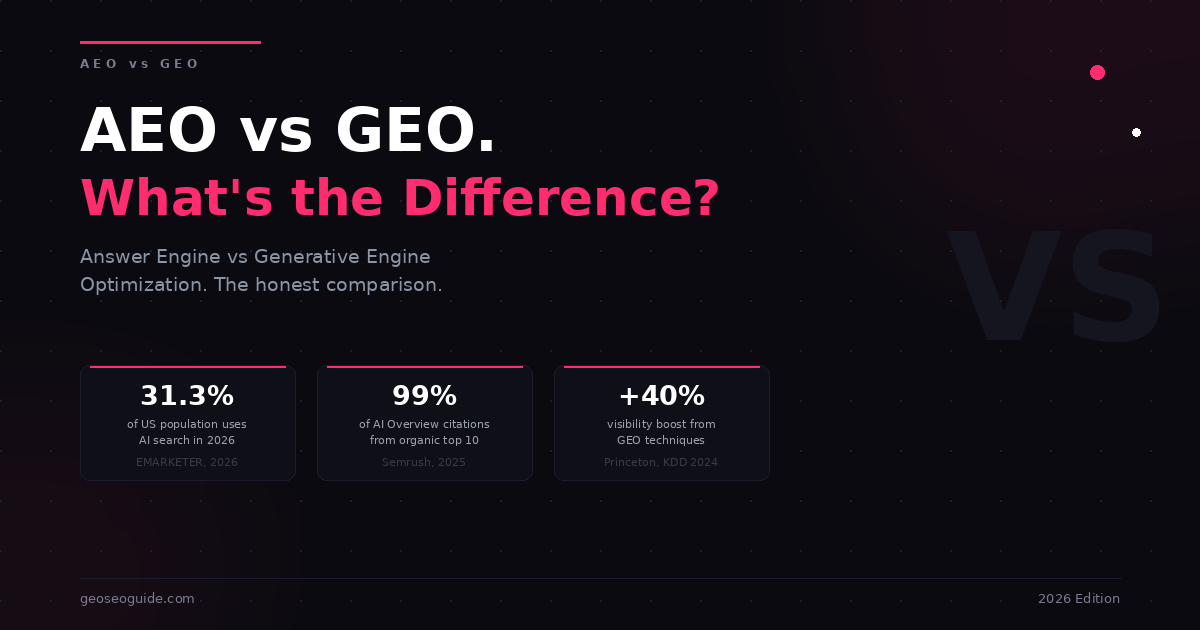
Answer Engine Optimization vs Generative Engine Optimization. Yes, There’s a Difference.
AEO and GEO sound interchangeable — and many marketers use them that way. But the strategies, formats, and success metrics are genuinely different. Here’s what each one actually means in 2026.
Walk into any marketing meeting in 2026 and you’ll hear three acronyms thrown around like they mean the same thing: SEO, AEO, and GEO. The first one is familiar. The other two are causing real confusion — and a lot of bad strategy decisions.
Some people insist AEO and GEO are essentially the same discipline with different branding. Others argue they’re fundamentally different approaches that require separate playbooks. According to a Search Engine Land analysis cited by EMARKETER, only 59% of SEO influencers reference GEO in their content, and fewer than one-third maintain consistent terminology throughout the year. The field is genuinely unsettled.
This guide cuts through the terminology mess. I’ll explain what AEO and GEO actually mean, where they overlap, where they diverge, and — most importantly — when you should prioritize one over the other. With real examples and data.
What Each Term Actually Means
Answer Engine Optimization (AEO)
Answer Engine Optimization is the practice of structuring content so it gets extracted and surfaced as a direct answer in AI-driven interfaces. AEO emerged when Google began displaying featured snippets and knowledge panels — the goal was simple: optimize content so search engines directly answer user queries with your information.
According to GenOptima’s framework, AEO is a narrower discipline focused specifically on winning the featured snippet, knowledge panel, or direct-answer position. AEO also applies to voice assistant responses — Alexa, Siri, Google Assistant — which typically read from the featured snippet.
AEO content characteristics: Short, direct answers (typically 40–60 words). Lists, tables, FAQs. Schema-driven. Snippet-friendly formatting. The goal is to be the answer, not part of an answer.
Generative Engine Optimization (GEO)
Generative Engine Optimization is the practice of structuring content and digital presence so AI-powered platforms cite, recommend, or mention your brand when users ask questions. The term was formally introduced by Princeton, Georgia Tech, and IIT Delhi researchers in their 2024 KDD paper.
GEO targets a fundamentally different output: multi-paragraph synthesized responses generated by ChatGPT, Perplexity, Gemini, Claude, and Google AI Overviews. Unlike AEO, where the goal is to be extracted verbatim, GEO aims to influence how AI systems describe your category, your strengths, and your relevance — even when your content is paraphrased rather than quoted.
GEO content characteristics: Longer, narrative-rich articles. Statistics and citations every 150–200 words. Comprehensive topic coverage. Authority signals. Entity-driven structure. The goal is to be part of the answer the AI synthesizes.
The Single Most Important Distinction
If you remember nothing else from this article, remember this: AEO captures demand. GEO shapes demand.
According to Paxcom’s 2026 analysis, AEO wins high-intent moments — when someone already knows what they’re looking for and just needs the answer fast. GEO secures presence earlier in the decision journey, where preferences are formed and shortlists are built.
Think about it from the user’s perspective. When someone types “what’s the boiling point of water” into Google, they want a quick answer extracted from a single source. That’s AEO territory. When the same person asks ChatGPT “what’s the best CRM for a mid-market SaaS company with 50 sales reps,” they want a synthesized recommendation drawing from multiple sources. That’s GEO territory.
Where AEO and GEO Converge
Despite the differences, AEO and GEO share substantial common ground — and that overlap is why so many marketers conflate them.
Both rely on clear, well-structured content. Both reward authority signals and credible sourcing. Both depend on a strong SEO foundation. As Jasper’s 2025 GEO/AEO analysis explains, traditional SEO remains important because generative engines rely on the same authority, clarity, and relevance signals that search algorithms have always valued.
Both also benefit from FAQ sections, schema markup, and answer-first content structures. The Princeton GEO research found that adding statistics improves AI visibility by up to 40% — a finding that applies equally to AEO outcomes (better featured snippets) and GEO outcomes (better citation rates in synthesized answers).
Both disciplines also share the same enemy: generic, ungrounded content with no clear answers. Whether you’re optimizing for an AEO snippet or a GEO citation, vague marketing copy is your worst enemy. Specificity wins in both worlds.
Where the Strategies Genuinely Diverge
The overlap is real, but so are the differences. Three key areas where AEO and GEO require genuinely different approaches:
Content Length and Depth
AEO rewards brevity. A 50-word direct answer often beats a 500-word explanation for snippet placement. GEO rewards comprehensive depth. Archetype’s analysis notes that GEO goes beyond single answers — it aims to become a primary source LLMs reference when composing multi-sentence or multi-paragraph outputs. A page that wins AEO might lose GEO if it lacks the contextual richness AI engines need to cite confidently.
Stability and Predictability
This is where things get interesting. EMARKETER’s principal analyst Nate Elliott put it bluntly: “If you query Google with the same question 10 times, you’ll get a pretty good sense for what Google’s going to tell you. I don’t know that we know that for GEO.” According to Search Engine Land data cited in the EMARKETER report, between 40% and 60% of cited sources change month-to-month across Google AI Mode and ChatGPT — making GEO visibility far less stable than AEO snippet wins.
Source Diversity
AEO relies almost exclusively on traditional Google ranking signals. GEO draws from a fundamentally different source mix. Reddit, LinkedIn, and YouTube ranked among the most-referenced domains by major LLMs in October 2025, according to EMARKETER. If your AEO strategy is purely on-site optimization, you’re missing roughly half of what drives GEO citations.
When to Prioritize AEO vs GEO
You shouldn’t actually choose between them — but if forced to prioritize, here’s the framework.
Prioritize AEO When:
Your audience asks specific, factual questions with clear right answers. You’re optimizing for voice search (Alexa, Siri, Google Assistant). Your business depends heavily on Google traffic and featured snippet placements. Your content niche is heavily query-driven (how-to guides, definitions, calculations). You’re in a market where users still convert primarily through Google clicks.
Prioritize GEO When:
Your buyers do extensive research before deciding (B2B SaaS, professional services, considered purchases). Your audience is already using ChatGPT and Perplexity for evaluation. Your category involves comparison and recommendation queries. Your brand competes on authority and thought leadership, not just keywords. You’re seeing AI referral traffic in GA4 (even small amounts indicate growing demand).
In 2026, you almost certainly need both. Treat them as complementary disciplines, not competing strategies.
AEO captures users who’ve already decided what they want. GEO influences what they decide they want in the first place. Skip either one and you leave revenue on the table.
How to Run AEO and GEO Together
Here’s the operational reality: most teams that succeed at both don’t separate them into different content workflows. They integrate the principles into a single content strategy.
For each major piece of content, layer in both. Start with a 40–60 word direct answer at the top (AEO). Follow with comprehensive, citation-rich expansion that AI engines can synthesize (GEO). Include FAQ schema (helps both). Use clear H2/H3 headings that mirror conversational queries (helps both). Add statistics and authoritative sources every 150–200 words (mostly GEO benefit, doesn’t hurt AEO).
The result is content that wins featured snippets and earns AI citations — without doubling your production effort. As Wellows’ AEO vs GEO guide notes, the winning brands don’t choose between the two — they design for both intentionally.
Frequently Asked Questions
Are AEO and GEO the same thing?
No. They share substantial overlap — both rely on structured, authoritative content — but they target different outputs. AEO targets featured snippets and direct answers in traditional search. GEO targets citations within multi-paragraph AI-generated responses across ChatGPT, Perplexity, Gemini, and other LLM platforms.
Which should I prioritize first?
Start with AEO if your business depends heavily on Google search and featured snippets. Start with GEO if your buyers do extensive research before deciding (B2B SaaS, professional services). Most businesses in 2026 need both — but the urgency of each depends on where your audience already searches.
Can the same content optimize for both AEO and GEO?
Yes, and this is the most efficient approach. Open with a 40–60 word direct answer (AEO win), then expand into a comprehensive, citation-rich article (GEO win). Add FAQ schema and clear H2/H3 headings for both. The same page can earn featured snippets and AI citations simultaneously.
Is GEO replacing AEO?
No. AEO remains highly relevant for voice search, traditional Google snippets, and direct-answer queries. GEO addresses a separate, faster-growing channel. They coexist — and the brands that win will be those that treat both as essential, not interchangeable.
How do success metrics differ between AEO and GEO?
AEO success is measured by featured snippet wins, voice search placements, and zero-click impressions in Google Search Console. GEO success is measured by AI citation frequency (AIGVR), brand mention share across LLM platforms, sentiment analysis, and AI referral traffic in GA4. Different KPIs, different tools, different reporting cadences.
- Princeton, Georgia Tech, IIT Delhi — GEO Research Paper (KDD 2024)
- Profound — AEO vs GEO: Why They’re the Same
- EMARKETER — FAQ on GEO and AEO (2026)
- Paxcom — AEO vs GEO Strategic Analysis
- GenOptima — GEO vs SEO vs AEO Differences
- Wellows — AEO vs GEO 2026 Guide
- Archetype — AEO vs GEO Comparison
- Jasper — GEO vs AEO vs SEO Guide
- Nowspeed — AEO vs GEO: Are They the Same?
- Affordable SEO FL — AEO vs GEO
- Semrush — 304,805 URL Study (99% citation overlap)
- Scrunch — Best AEO/GEO Tools for 2026