Why Is Generative Engine Optimization Important? Because AI Already Replaced the Blue Link.
Your customers aren’t scrolling search results anymore. They’re asking AI — and AI is answering. If your brand isn’t part of that answer, you’ve already lost the deal.
Here’s a scenario that’s playing out right now, thousands of times per hour. A VP of Marketing opens ChatGPT and types: “What are the best account-based marketing platforms for mid-market SaaS?” The AI doesn’t return a list of ten blue links. It synthesizes information from dozens of sources, names specific brands, compares features, and delivers a direct recommendation — all in about four seconds.
If your brand isn’t in that answer, you don’t exist for that buyer. Not in the “they’ll find us eventually” sense. In the “they’ve already made a shortlist and we’re not on it” sense.
That’s why Generative Engine Optimization matters. Not as a nice-to-have. Not as a future trend to watch. As an urgent strategic priority for any business that depends on being discovered online.
This isn’t theoretical. The data is overwhelming, the case studies are real, and the window for early-mover advantage is shrinking fast. Let me walk you through exactly why GEO has become essential in 2026 — backed by numbers, not hype.
The Way People Search Has Fundamentally Changed
For two decades, search meant one thing: type keywords into Google, scan a list of links, click the most promising one. That model is collapsing. Not slowly. Not gradually. Right now.
ChatGPT processes over 2.5 billion prompts daily with 800 million weekly active users. Perplexity AI surpassed 780 million monthly queries by mid-2025 — a 239% increase in under a year. Google’s AI Overviews now appear in 60.3% of US searches. And 58% of consumers have already replaced traditional search engines with AI tools for product and service discovery.
The result? According to SparkToro’s data cited by Stormy AI, 70% of search queries now result in zero clicks. Users get their answer directly inside the AI interface. The journey ends before a single website is visited.
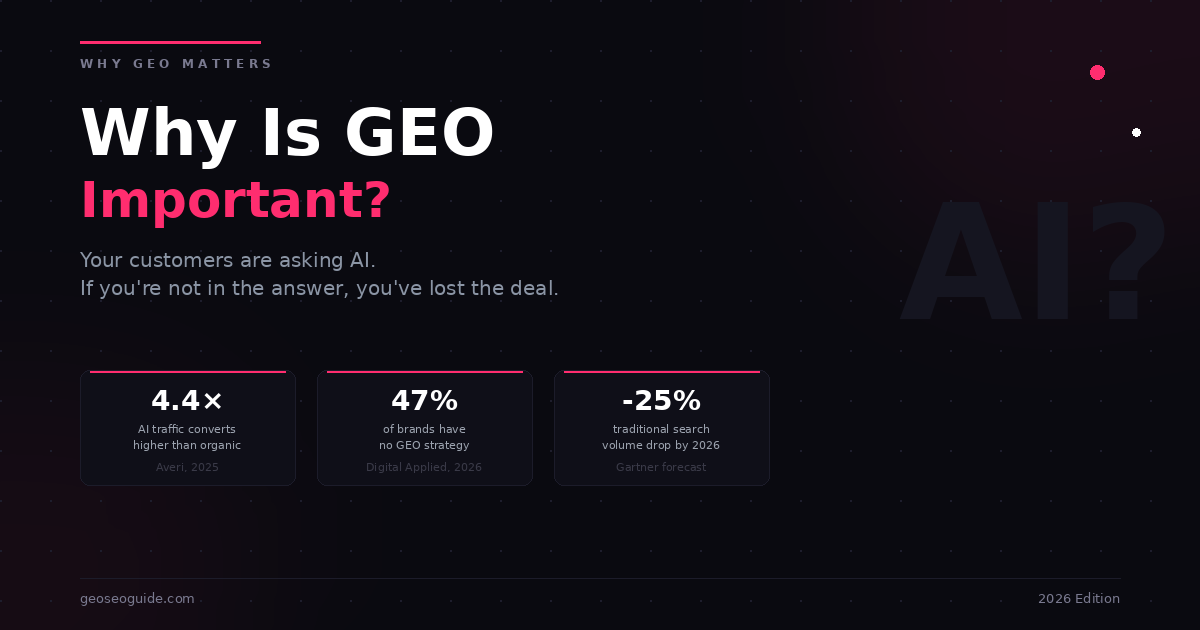
Gartner predicts traditional search volume will drop 25% by the end of 2026. This isn’t a marginal decline. It’s a quarter of all search traffic migrating to AI-powered answer engines in a single year.
If your entire marketing strategy is built on earning clicks from Google’s organic results, you’re optimizing for a channel that’s actively shrinking. That’s not pessimism. That’s arithmetic.
SEO Alone No Longer Guarantees Visibility
Here’s the part that catches most marketers off guard. You can rank #1 on Google for your target keyword — and still be completely invisible in AI-generated answers.
According to eMarketer’s 2026 GEO report, fewer than 10% of the sources cited in ChatGPT, Gemini, and Copilot rank in Google’s top 10 organic results for the same query. Read that again. The content AI chooses to cite has almost no overlap with what Google ranks highest.
This creates a dangerous blind spot. Your SEO dashboard says everything is fine — rankings stable, traffic steady — while an entirely separate discovery channel is growing exponentially and your brand doesn’t exist in it. As Search Engine Land puts it, GEO is no longer optional in 2026.
At the same time, the reverse is also true. Semrush’s study of 304,805 URLs found that 99% of Google AI Overview citations come from the organic top 10. So SEO is still essential for Google’s own AI — but it’s insufficient for ChatGPT, Perplexity, Claude, and the rest.
This is exactly why GEO matters: it fills the visibility gap that SEO alone cannot cover.
GEO Directly Affects Revenue, Not Just Visibility
If GEO were just about brand awareness in AI answers, you could argue it’s a nice-to-have. It’s not. The data shows a direct line from AI citations to revenue.
AI Traffic Converts at Dramatically Higher Rates
Visitors referred by AI platforms arrive with fundamentally different intent. They’ve already done their evaluation inside the AI conversation. By the time they click through, they’re not browsing — they’re buying. Averi’s analysis shows AI traffic converting at 14.2% versus 2.8% for organic — a 4.4× premium. Seer Interactive found ChatGPT visitors viewing 2.3 pages per session, nearly double organic’s 1.2 pages.
The First-Mover Flywheel Is Real
The Princeton GEO research paper identified a “source preference flywheel” — AI systems that cite you once are more likely to cite you again. Early visibility compounds. The brands that establish authority in AI responses today will own the conversations in their industries tomorrow.
This isn’t just academic theory. Tally.so, an eight-person form builder startup, saw ChatGPT become their #1 referral source, driving 3,000+ leads per week and helping them hit $3M ARR five months ahead of schedule. IEEE Spectrum’s AI referral traffic doubled in six months. These aren’t outliers — they’re early signals of a pattern.
Discovery Now Begins and Ends Inside AI
This is the most important shift to understand. As Digital Authority Partners explains, GEO matters for business growth because it intercepts prospects at the discovery phase — and that discovery can now begin and end within the AI loop, without the prospect ever clicking to learn more.
A Pew Research study found that 58% of users in a test group were satisfied with their search results and chose to stay within the AI summary experience. They never needed a website. If your brand wasn’t in that summary, you never had a chance.
AI Doesn’t Rank Pages. It Chooses Trusted Sources.
The fundamental difference between SEO and GEO comes down to how discovery works. Google presents a list and lets users choose. AI engines choose for the user. When ChatGPT names your brand in a response, it delivers an implicit endorsement no organic listing ever could.
LLMs typically cite only 2 to 7 domains per response — far fewer than Google’s 10 blue links. The competition for those citation slots is intense, and the selection criteria are different from traditional ranking factors.
According to The Digital Bloom’s AI Visibility Report, brand search volume — not backlinks — is the strongest predictor of AI citations, with a 0.334 correlation. That means brand-building activities like PR, community engagement, and third-party mentions directly influence whether AI systems cite you.
The Princeton research confirmed that specific optimization techniques make a measurable difference: adding statistics improves AI visibility by up to 40%, citing authoritative sources boosts citation probability, and including expert quotations strengthens trust signals. Traditional keyword stuffing, on the other hand, performed poorly in generative contexts.
This means the content that wins in GEO is fundamentally different from content that wins in SEO. It’s not about keyword density. It’s about fact density, source attribution, structural clarity, and entity authority across the web.
Different AI Platforms, Different Rules — You Need Coverage Everywhere
Another reason GEO is essential: the AI landscape is fragmented. Each platform has distinct citation behavior, and optimizing for one doesn’t guarantee visibility on another.
- Favors Wikipedia & encyclopedic content
- 87% citations match Bing (not Google) top 10
- 3.2× more mentions than actual links
- 71% of Americans use it for purchase research
- Reddit is #1 cited source (6.6%)
- Real-time retrieval — freshness wins
- 21.87 citations per answer (3× ChatGPT)
- Highest citation diversity of any platform
- 99% citations from organic top 10
- Requires traditional SEO as foundation
- Favors YouTube & multi-modal content
- 200+ countries, 40+ languages
According to Averi’s analysis of 680 million citations, only 11% of domains are cited by both ChatGPT and Perplexity. One-size-fits-all optimization misses most of the opportunity. And Foundation’s research found that about 48% of AI citations come from community and user-generated platforms — Reddit appears in roughly 1 in 5 AI answers.
GEO gives you a systematic approach to building visibility across all of these platforms simultaneously, rather than hoping your Google SEO happens to carry over.
The GEO Market Is Exploding — And Most Competitors Haven’t Started
The GEO market was valued at $886 million in 2024 and is projected to reach $7.3 billion by 2031 — an eightfold increase at 34% CAGR. Yet only 23% of marketers currently invest in prompt tracking and GEO measurement.
According to a Digital Applied survey, 47% of brands lack a GEO strategy entirely. By early 2026, most enterprise marketing teams have a GEO initiative — but most small and mid-size businesses haven’t started yet.
That gap is your opportunity. The Princeton researchers’ “source preference flywheel” means the brands that establish AI visibility first tend to keep it. Waiting doesn’t just delay results — it makes catching up exponentially harder.
47% of brands have no GEO strategy. Only 23% measure AI visibility. The first-mover advantage is still wide open.
But the window is closing. AI-driven retail traffic surged 4,700% YoY by mid-2025. The brands moving now are building compounding advantages.
GEO Matters Across Every Industry — Not Just Tech
It’s tempting to think GEO only matters for SaaS companies and digital-native brands. The data says otherwise.
Healthcare
Clinicians and patients increasingly use AI tools to evaluate treatment options, devices, and providers. MarGen’s 2026 guide notes that structured, citation-rich clinical content is now the foundation of visibility in this vertical. If a patient asks ChatGPT “what’s the best treatment for [condition]” and your medical practice isn’t cited, you’ve lost that patient to whoever is.
Legal & Professional Services
71% of Americans already use AI search to research purchases or evaluate service providers. For law firms and consultancies, being named in an AI-generated shortlist is the new equivalent of a top-three Google ranking. As One400’s legal industry GEO analysis explains, GEO isn’t just about visibility — it’s about reducing the likelihood that AI tools fill the gap with inaccurate summaries about your practice area.
E-commerce & Retail
AI-driven retail traffic surged 4,700% year-over-year by mid-2025. Product descriptions, reviews, and comparison content optimized for LLM extraction are now revenue-critical assets. When someone asks Perplexity “best running shoes under $150,” the brands cited in that response capture the sale.
B2B & Supply Chain
Corporate Ink’s supply chain analysis makes a critical point: if a CSCO asks ChatGPT “what supply chain tech solutions best mitigate manufacturing risk?” and your brand doesn’t appear, you’re not part of the buying decision. 89% of B2B buyers now use generative AI during their purchasing journey.
What to Do About It: Your GEO Starting Point
Understanding why GEO matters is step one. Acting on it is step two. Here’s where to start.
Audit Your Current AI Visibility
Before you optimize anything, you need a baseline. Test your most important topic queries in ChatGPT, Perplexity, and Google AI to see whether your brand is cited. Tools like HubSpot’s free AI Search Grader or Otterly.AI’s trial can provide an initial snapshot. If you’re invisible, that’s your starting point.
Structure Content for AI Extraction
Answer the primary question in your first 40–60 words. Include a citable statistic every 150–200 words. Use clear H2/H3 headings that mirror conversational queries. Add FAQ schema, Organization schema, and “Last updated” dates. These structural changes — based on the Princeton GEO study — can improve AI visibility by up to 40%.
Build Entity Authority Beyond Your Website
AI systems assess your brand across the entire web. Invest in Reddit engagement, review platforms (G2, Trustpilot), Wikipedia presence, YouTube content, and earned media. Corporate Ink emphasizes that PR has never been more important — LLMs heavily weigh third-party credibility signals including media coverage, awards, analyst validation, and customer proof points.
Measure and Iterate
Set up GA4 regex filters to track AI referral traffic. Monitor citation frequency across platforms monthly. Track branded search volume for correlation with AI mentions. Start with these basics, then layer in dedicated GEO tools as you scale.
Frequently Asked Questions
Does GEO replace SEO?
No. GEO extends SEO into AI-powered channels. SEO remains essential — 99% of Google AI Overview citations come from the organic top 10. But SEO alone doesn’t guarantee visibility in ChatGPT, Perplexity, or Claude, where fewer than 10% of cited sources overlap with Google’s top results.
Is GEO only relevant for tech companies?
No. GEO impacts every industry. Healthcare providers, law firms, e-commerce brands, supply chain companies, and local businesses all face the same reality: their customers are asking AI for recommendations. If you’re not optimized for AI visibility, you’re invisible to a growing portion of your market.
How quickly can GEO produce results?
Perplexity retrieves content in real-time, so structural improvements can show results within days. ChatGPT’s training data has a longer lag — weeks to months. Google AI Overviews depend on your organic rankings. Plan for a 3–6 month timeline for comprehensive results, with some quick wins within weeks.
What’s the ROI of GEO investment?
AI traffic converts at 4.4× the rate of organic search (14.2% vs 2.8%). Companies using AI in their marketing report +22% higher ROI than average. 63% of companies that have optimized for GEO notice an increase in visibility. The ROI case strengthens as AI adoption grows.
Where should I start with GEO?
Run your top 10 target queries through ChatGPT and Perplexity. If your brand doesn’t appear, that’s your starting signal. Then focus on content structure (answer-first format, stats every 150 words, cited sources), entity authority (Wikipedia, Reddit, review sites), and measurement (GA4 AI traffic filters).
- Ahrefs — AI Overviews CTR Impact Study (Dec 2025)
- Princeton, Georgia Tech, IIT Delhi — GEO Research Paper (KDD 2024)
- Semrush — 304,805 URL Content Optimization Study
- Averi — GEO Metrics and AI Citation Tracking Guide (2026)
- Seer Interactive — How Traffic from ChatGPT Converts
- Stormy AI — GEO Playbook 2026 (SparkToro data)
- eMarketer — Generative Engine Optimization in 2026
- Search Engine Land — Mastering GEO in 2026: Full Guide
- Frase.io — GEO Complete Guide (2026)
- MarGen — The Definitive Guide to GEO in 2026
- Incremys — 2026 GEO Statistics
- Enrich Labs — GEO Complete Guide 2026
- Geoptie — Definitive GEO Guide (Gartner forecast)
- The Digital Bloom — 2025 AI Visibility Report
- Averi — B2B SaaS Citation Benchmarks (680M citations)
- Foundation — Complete Guide to GEO (2026)
- Digital Authority Partners — GEO for Businesses in 2026
- Digital Applied — GEO Guide 2026
- One400 — GEO for Legal Industry (2026)
- Corporate Ink — GEO for Supply Chain (2026)
- Qwairy — Tally.so GEO Case Study
- RebelMouse — IEEE Spectrum AI Traffic Study
- Superlines — AI Search Statistics
- Single Grain — GEO Case Studies