How to Measure the Success of GEO Campaigns — KPIs That Actually Matter.
Your rankings are green. Your traffic looks fine. But do you know what ChatGPT said about your brand yesterday? Here are the metrics, tools, and frameworks that replace guesswork with real measurement.
Your SEO dashboard says everything is fine. Rankings are stable. Organic traffic is holding. But here’s what your dashboard can’t show you: yesterday, ChatGPT answered 2.5 billion prompts, and your brand wasn’t mentioned in a single relevant response.
That blind spot is the entire reason Generative Engine Optimization measurement exists. And if you’re investing in GEO — or thinking about it — the first question you’ll face from any stakeholder is brutally simple: how do we know it’s working?
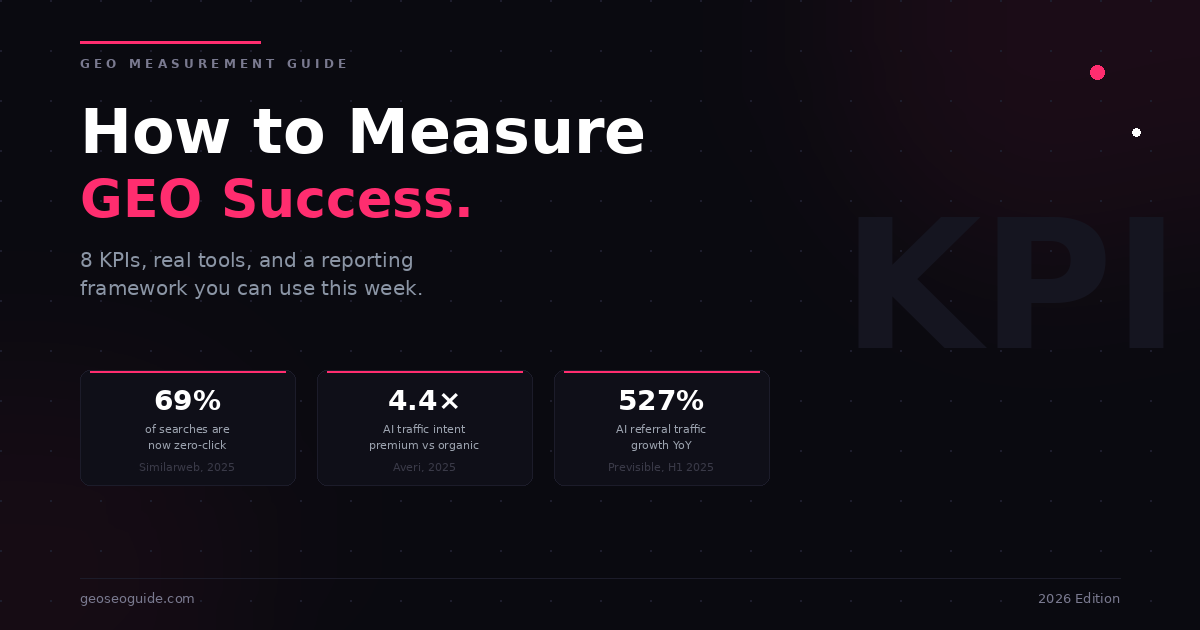
The problem is that traditional SEO metrics don’t translate cleanly into the world of AI-generated answers. Rankings don’t exist the same way. Clicks happen less often. And influence is exerted inside the AI response itself — before anyone visits your website. According to Similarweb’s GEO KPI guide, zero-click searches now account for roughly 69% of Google queries, and AI summaries appear in about 18% of searches, typically citing three or more sources.
This guide breaks down every metric that matters for measuring GEO success in 2026, the tools you can use at every budget level, and a practical reporting framework you can actually present to your team. No fluff. Just measurement.
Why Traditional SEO Metrics Fail in a Generative World
Before diving into what to measure, it’s worth understanding why your current metrics are insufficient. The gap isn’t minor — it’s structural.
In traditional SEO, performance measurement assumes a stable output. Pages are indexed, ranked, and presented as links. Metrics like impressions, clicks, CTR, and average position work because the system is deterministic. As a Digital Agency Network analysis explains, SEO measurement is tied to retrieval visibility — whether a document is returned and selected by a user from a list.
GEO operates under a completely different model. Generative systems don’t work with fixed positions. There isn’t a page one to win or a stable slot to defend. Answers are assembled in real time, shaped by context, phrasing, and intent. The same question asked slightly differently can produce a completely different set of cited sources.
This creates what Interactgen calls an “attribution paradox”: your most effective discovery channel appears invisible in standard analytics. When someone discovers your brand through an LLM and visits later, it shows up as direct traffic. CTRs drop 32% for top results after AI Overview rollout, yet brands cited within those AI answers see increased branded search volume.
The bottom line: if you’re measuring GEO with SEO logic, you’re measuring the wrong thing. Rankings, page traffic, and click-through rates are still relevant for traditional search. But for generative search, you need an entirely new set of KPIs.
The 8 GEO KPIs Every Marketing Team Should Track
Based on frameworks from Similarweb, LLM Pulse, Interactgen, and ELCA, here are the metrics that matter. I’ve organized them from foundational (start here) to advanced (layer in over time).
1. AI-Generated Visibility Rate (AIGVR)
This is your foundational metric. AIGVR measures the percentage of target prompts where your brand appears in AI responses across all monitored platforms. Think of it as your “share of answers” — how often AI considers your brand relevant enough to include.
According to Interactgen’s GEO KPI framework, you should track this weekly using 20–30 core prompts relevant to your category. A low AIGVR either signals a lack of content relevant to the model’s prompts or insufficient authority.
How to measure it: Pick 20–30 prompts your target audience would ask. Run them weekly across ChatGPT, Perplexity, and Google AI Overviews. Track how many responses mention your brand. Your AIGVR is: (responses mentioning you / total responses monitored) × 100.
2. Brand Mention Share (AI Share of Voice)
While AIGVR measures whether you appear at all, Brand Mention Share measures how often you’re mentioned relative to competitors. Similarweb’s Limor Barenholtz describes this as share-of-voice for generative answer engines.
This is the metric that reveals competitive momentum. If competitors are gaining mentions faster than you, your authority may be eroding — even if your absolute numbers look stable. Track this monthly and benchmark against your top 3–5 competitors.
3. Citation Rate and Citation Quality
Not every brand mention results in a citation. As LLM Pulse explains, mentions indicate narrative presence, while citations indicate source dependency. A citation means the AI linked back to your content as a source — a much stronger trust signal.
Track both the raw citation count and the quality: are you cited as a primary source or a supporting reference? Are you cited early in the response (higher authority) or buried at the end? Citation position within the answer correlates with perceived authority.
4. Brand Sentiment in AI Responses
Being mentioned isn’t always good. What matters equally is how AI describes your brand. According to Analytica House’s GEO reporting model, the tone AI uses when mentioning your brand — positive, neutral, or negative — is decisive for brand perception.
This is qualitative measurement, but it’s critical. If Perplexity describes your product as “a budget alternative with limited features,” that’s technically a mention. It’s not a win. Most dedicated GEO tools now include sentiment scoring.
5. AI Referral Traffic and Conversion Rate
This is where GEO connects to revenue. Set up analytics filters to isolate traffic from AI platforms. Seer Interactive recommends using a regex pattern matching chatgpt, perplexity, gemini, claude, copilot, and openai as referral sources.
Then track the conversion rate of that traffic separately. AI-referred visitors convert at dramatically higher rates in B2B contexts — Averi reports 14.2% compared to Google’s 2.8%, a 4.4× premium. Fewer visits, but much higher intent.
6. Content Extraction Rate (CER)
This metric measures how effectively AI systems extract and use specific claims from your content. According to Go Fish Digital, CER reveals whether your content structure is actually AI-friendly — or whether AI systems skip over your pages even when they’re authoritative.
How to measure it: Identify your key factual claims (stats, definitions, comparisons). Search for those claims in AI responses. Track whether the AI attributes them to you or to a competitor. Low CER means your content is authoritative but not structured for extraction.
7. AI Crawler Activity
Before AI can cite you, it needs to crawl you. Monitor your server logs for AI bot activity — GPTBot (OpenAI), PerplexityBot, Google-Extended, ClaudeBot, and others. Go Fish Digital notes this is the most accurate way to track when ChatGPT or other AI tools pull your content into answers — data that GA4 completely misses.
Track crawl frequency, crawl depth (how many pages), and which content they’re accessing most. Tools like Profound and Qwairy now offer dedicated AI crawler analytics dashboards.
8. Branded Search Lift from AI Mentions
This is the bridge between GEO and traditional SEO. When AI platforms mention your brand, it often triggers increased branded search on Google. As LLM Pulse notes, “we get more leads from people who discovered us via ChatGPT than from direct traffic coming from ChatGPT itself.”
Monitor your branded search volume in Google Search Console and correlate spikes with periods of increased AI visibility. This is often the easiest way to demonstrate GEO ROI to stakeholders who think in traditional SEO terms.
GEO Measurement Tools at Every Budget Level
The GEO tool landscape has exploded in the past year. Here’s what’s available in 2026, organized by budget.
- HubSpot AI Search Grader (free)
- Manual prompt testing + spreadsheet
- GA4 regex filters for AI traffic
- Otterly.AI Lite ($29/mo, 10 prompts)
- Qwairy (full-stack GEO platform)
- Semrush AI Toolkit ($99/mo add-on)
- Otterly Standard ($189/mo)
- Peec AI / Superlines (~€89/mo)
- Profound ($499+, SOC 2, HIPAA)
- Conductor AI module
- BrightEdge AI features
- Custom integrations + GA4 + BI
For most teams, the practical starting point is this: use HubSpot’s free AI Search Grader for an initial assessment, set up GA4 regex filters to isolate AI referral traffic (costs nothing), and then invest in a paid monitoring tool once you’ve confirmed AI traffic is relevant to your business.
As Geoptie’s tool comparison notes, the sweet spot for most teams falls in the $79–199/month range — tools like Qwairy, Semrush AI Toolkit, and Otterly Standard offer actionable features without enterprise complexity.
A Practical GEO Reporting Framework (Copy This)
Knowing which metrics exist and actually building a reporting cadence are two different things. Here’s a framework you can implement this week.
Weekly Check (15 minutes)
Run your 20–30 core prompts across ChatGPT and Perplexity. Log whether your brand appeared (AIGVR). Note any new competitor mentions. Check GA4 AI referral traffic for anomalies. This is your pulse check — you’re looking for trends, not perfection.
Monthly Report (for stakeholders)
Compile AIGVR trend (is visibility growing?), Brand Mention Share vs. competitors, citation count and quality, AI referral traffic volume and conversion rate, and branded search volume correlation. Present this alongside your traditional SEO report — not as a replacement, but as an additional layer.
Quarterly Deep Dive
Audit sentiment across platforms. Review which content pages are getting cited most — and which authoritative pages are being ignored. Analyze AI crawler logs for crawl frequency trends. Compare GEO performance across ChatGPT vs. Perplexity vs. Google AI Overviews separately — they behave very differently. Adjust your content strategy based on which platforms are driving the most value.
Start with AIGVR and AI referral traffic. Layer in sentiment and citation quality. Connect everything to revenue.
You don’t need all 8 KPIs on day one. But you need to start measuring something — because right now, most of your competitors aren’t.
5 Measurement Mistakes That Kill GEO Campaigns
1. Using SEO KPIs as a proxy for GEO performance
Rankings and organic traffic tell you about Google’s traditional results. They tell you nothing about what ChatGPT, Perplexity, or Claude are saying about your brand. These are separate channels with separate signals — measure them separately.
2. Tracking mentions without tracking sentiment
A brand mention in a negative context is worse than no mention at all. “Brand X is overpriced compared to alternatives” technically increases your AIGVR. It destroys your conversion potential. Always pair mention volume with sentiment analysis.
3. Measuring a single platform and assuming the rest follow
Only 11% of domains are cited by both ChatGPT and Perplexity. What works on one platform may be completely invisible on another. Your measurement framework needs to cover all platforms your audience actually uses.
4. Expecting instant results
GEO measurement is about building consistent presence over time. AI models update their knowledge at different intervals. Perplexity retrieves in real-time; ChatGPT’s training data has a lag. A content update might show up in Perplexity within hours but take weeks to influence ChatGPT. Set realistic timelines for each platform.
5. Not connecting GEO metrics to business outcomes
Citation share is meaningless to a CFO. Revenue from AI-referred traffic isn’t. Always build the bridge between visibility metrics (AIGVR, mention share) and business metrics (leads, conversions, pipeline). The AI referral → conversion path is your strongest ROI argument.
Frequently Asked Questions
What’s the single most important GEO metric to start with?
AI-Generated Visibility Rate (AIGVR). It answers the most fundamental question: does AI know you exist? Start with 20–30 prompts relevant to your category and track weekly. Everything else builds on this foundation.
Can I measure GEO for free?
Yes. HubSpot’s AI Search Grader is free. Manual prompt testing across ChatGPT and Perplexity with a spreadsheet costs nothing but time. And GA4 regex filters to isolate AI referral traffic are free to set up. You won’t get automated tracking, but you’ll get a clear baseline.
How often should I report on GEO performance?
Weekly pulse checks (15 minutes), monthly stakeholder reports, and quarterly deep dives. GEO changes more slowly than paid media but faster than traditional SEO — monthly reporting captures the meaningful movements without creating noise.
Do GEO tools guarantee my brand will appear in AI responses?
No. AI responses are non-deterministic — they vary based on prompts, context, and model updates. No tool can guarantee citations. What they do is help you understand what content gets cited, identify gaps, and optimize to increase citation probability over time.
How do I prove GEO ROI to my CFO?
Three data points: (1) AI referral traffic converting at 4.4× the rate of organic, (2) branded search volume increases correlated with AI mention periods, and (3) revenue attributed to AI-referred conversions via GA4. Pair citation metrics with conversion data and the ROI case writes itself.
- Similarweb — GEO KPIs: How to Measure the Right Metrics (Dec 2025)
- LLM Pulse — GEO Metrics for Competitive Visibility in 2026
- Interactgen — 11 GEO KPIs to Measure Success in AI-Driven Search
- ELCA — Generative Engine Optimization Metrics & KPIs
- Digital Agency Network — Measuring GEO KPI: Tracking Success (Jan 2026)
- Analytica House — GEO KPI Reporting Model for AI Visibility (Feb 2026)
- Go Fish Digital — Measuring GEO Impact (2025)
- Averi — GEO Metrics That Matter: Track AI Citations (2026)
- Seer Interactive — How Traffic from ChatGPT Converts
- Geoptie — 11 Best GEO Tools in 2026
- Qwairy — Best GEO Platforms Compared (2026)
- Hashmeta AI — GEO Performance Metrics Guide (Dec 2025)
- Stormy AI — GEO Playbook for 2026 (Mar 2026)
- Superlines — AI Mode Zero-Click Data (Semrush, Sep 2025)