Does Generative Engine Optimization Work for All Types of Websites? The Honest Answer.
GEO works for every website — but not equally. The strategy, timeline, and ROI vary dramatically depending on your business model. Here’s what the data shows for each type.
When people hear about Generative Engine Optimization for the first time, one question comes up almost immediately: does this apply to my kind of business?
The short answer is yes. If your customers use AI to research, compare, or make decisions — and increasingly, they all do — then GEO is relevant. ChatGPT processes 2.5 billion prompts daily. 71% of Americans already use AI search for purchase research. These aren’t niche behaviors anymore.
But here’s the longer, more honest answer: GEO works for all types of websites, but the strategy, priority level, expected timeline, and ROI differ significantly depending on your business model. A B2B SaaS company with a long sales cycle will approach GEO very differently from a local plumber. Both can benefit. Neither should copy the other’s playbook.
Let me break down exactly how GEO applies to each major website type — with real data, real examples, and honest assessments of where the biggest opportunities (and limitations) lie.
B2B SaaS and Technology: Where GEO Delivers the Strongest ROI
If there’s a single website category where GEO is already delivering undeniable results, it’s B2B SaaS. The reason is structural: B2B buyers do extensive research before making purchasing decisions, and AI tools are rapidly becoming their primary research channel.
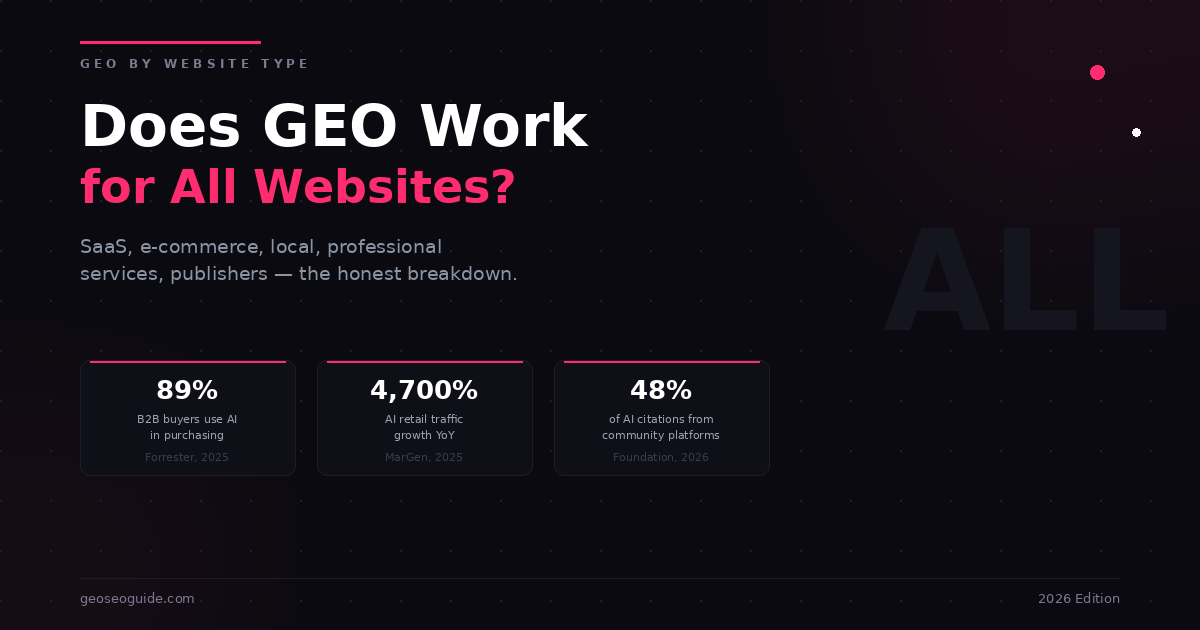
According to data cited across multiple industry reports, 89% of B2B buyers now use generative AI during their purchasing journey. When a VP of Engineering asks ChatGPT “what’s the best CI/CD platform for mid-market teams?” and your brand isn’t cited, you’re excluded from the consideration set before your sales team even knows a deal existed.
The case studies are compelling. Tally.so — an eight-person form builder — hit $3M ARR five months early, with ChatGPT as their #1 referral source. Vercel now gets 10% of signups from ChatGPT alone, up from 1% just six months earlier. Single Grain documented 367% organic traffic growth for a B2B SaaS client implementing GEO.
Why it works so well: B2B buyers ask comparison and evaluation questions that AI answers love to synthesize. Long sales cycles mean the AI citation happens early and shapes the entire funnel. Content-heavy websites with case studies, documentation, and thought leadership give AI engines rich material to draw from.
GEO priority level: Critical. Start now.
E-Commerce: Massive Opportunity, But the Playbook Is Different
AI-driven retail traffic surged 4,700% year-over-year by mid-2025. Amazon Rufus, ChatGPT with shopping features, and Perplexity’s product recommendations are reshaping how consumers discover products. When someone asks “best running shoes under $150 for flat feet,” the brands in that AI answer capture the sale.
But e-commerce GEO requires a different approach than B2B. You’re optimizing product descriptions, comparison content, and reviews — not thought leadership whitepapers. As Kensium’s ecommerce GEO analysis explains, AI engines prefer clarity over creativity — ambiguous marketing language performs poorly in generative summaries. Product specs, honest comparisons, and structured data outperform clever copy.
One caveat: a Search Engine Land study of 973 ecommerce sites found that ChatGPT referral traffic still trails Google organic on ecommerce conversion rates specifically. The volume is growing fast, but it hasn’t hit parity yet. Products that require research and comparison (electronics, outdoor gear, beauty) benefit more than impulse purchases.
Why it works: Product queries are inherently comparison-driven — exactly what AI answers excel at. Rich structured data (Product schema, Review schema, Price schema) gives AI engines confidence to cite you.
GEO priority level: High — especially for considered purchases. Start with your top product categories.
Local Businesses: GEO Is Coming for You Faster Than You Think
If you’re a dentist, plumber, restaurant, or local service provider, you might assume GEO is for big companies. That assumption is already outdated.
People are asking AI “best dentist near me that accepts Delta Dental” or “emergency plumber in [city] with same-day service.” GEO agencies like Siana Marketing have built entire practices around local-first GEO, serving clients in real estate, construction, architecture, and professional services. Their methodology centers on AI citation frequency, thought leadership content, and local brand authority.
For local businesses, GEO overlaps heavily with local SEO — but adds critical layers. Your Google Business Profile, reviews on Yelp and Google, mentions in local directories, and LocalBusiness schema markup all feed into whether AI recommends you. As Finch’s GEO overview puts it, GEO is about making your organization “retrievable and recommendable” across AI systems — and that applies whether you’re a Fortune 500 or a three-person law firm.
Why it works: Local queries have clear intent, and AI answers love giving specific recommendations. A well-optimized local business with strong reviews and structured data can dominate AI responses in their geographic area.
GEO priority level: Medium-high and rising fast. Start with schema markup, review management, and local content.
Professional Services: Law, Finance, Healthcare, Consulting
Professional services represent one of the highest-stakes GEO categories. When someone asks ChatGPT about legal rights, tax strategies, or medical symptoms, the AI’s response shapes real decisions with real consequences.
One400’s legal industry analysis makes a crucial point: GEO for professional services isn’t just about visibility — it’s about reducing the likelihood that AI tools fill the gap with inaccurate summaries. If your law firm’s content isn’t structured for generative engines, the AI might pull from forums, outdated articles, or non-legal publishers when answering questions about your practice area.
71% of Americans already use AI search to evaluate service providers. For law firms, consultancies, financial advisors, and healthcare practices, being named in an AI-generated shortlist is the new equivalent of a top-three Google ranking.
E-E-A-T (Experience, Expertise, Authoritativeness, Trustworthiness) matters enormously here. AI engines prioritize content written by credentialed authors with verifiable expertise. A health article written by a doctor, or a financial analysis from an accredited institution, has significantly higher citation probability.
Why it works: Professional services queries are high-intent and research-driven. Clients do extensive due diligence, and AI is becoming their first stop. Credentialed, structured content has a natural advantage.
GEO priority level: High. The trust signals that professional services already build (credentials, case studies, authoritative content) translate directly into AI citation authority.
Content Publishers and Media: The Complex Relationship
Publishers have the most complicated relationship with GEO. On one hand, they’re the primary source material AI engines draw from. On the other, AI answers often reduce the need to click through to the original article — creating a direct threat to ad-supported business models.
IEEE Spectrum saw their AI referral traffic double in the first half of 2025, with ChatGPT accounting for 94% of the mix. Their deep, expert-driven content earns consistent citations. But many publishers report traffic losses of up to 40% when AI summaries appear above their content.
The key variable is content depth. Surface-level news aggregation loses to AI summaries. Deep, original reporting and expert analysis gets cited by AI summaries. Publishers who invest in original research, proprietary data, and authoritative expert commentary are finding GEO to be a growth channel. Those who rely on thin, commodity content are finding it’s a threat.
Roughly 80% of top news publishers now block at least one AI training crawler via robots.txt. This creates a content scarcity dynamic — publishers that make their content AI-accessible and well-structured gain an outsized advantage.
Why it works (when it does): AI engines need authoritative source material. Publishers that provide unique, in-depth, expert-driven content become default citation targets.
GEO priority level: High, but strategy varies. Commodity content sites should be cautious; original-reporting sites should lean in hard.
Personal Brands, Portfolios, and Small Niche Sites
This is where GEO gets more nuanced. A personal portfolio site for a freelance designer or a small hobby blog doesn’t have the same GEO dynamics as a SaaS company or an e-commerce store.
The honest assessment: pure portfolio sites (showcasing work with minimal text content) have limited GEO potential. AI engines need textual content to extract and cite. A gallery of images without structured, fact-dense text gives AI nothing to work with.
However, personal brands that produce thought leadership content are a different story entirely. If you’re a freelance consultant who publishes in-depth guides, case studies, and original frameworks, you can absolutely earn AI citations — and those citations can drive high-intent leads directly to you. The Princeton research showed that adding statistics and citing sources improves AI visibility by up to 40%, regardless of whether you’re a solo practitioner or a global enterprise.
Small niche sites can also punch above their weight. As Kensium notes, mid-market brands often gain disproportionate visibility in niche, high-intent queries when content is structured properly. AI doesn’t care about your company size — it cares about content quality, clarity, and authority.
GEO priority level: Low for pure portfolio sites. Medium-high for personal brands with content strategies.
GEO Effectiveness by Website Type: At a Glance
What Works for Every Website Type: The GEO Fundamentals
Regardless of your website category, certain GEO principles apply universally. These are the non-negotiables that every site should implement.
Structure Content for AI Extraction
Answer the primary question in the first 40–60 words. Use clear H2/H3 headings that mirror conversational queries. Include a specific, citable claim every 150–200 words. The Princeton GEO study found that adding statistics improves visibility by up to 40% — this applies to a law firm website just as much as a SaaS blog.
Implement Structured Data Markup
FAQ, Organization, Product, LocalBusiness, Article, and Person schema types give AI engines explicit, machine-readable context. As Finch explains, schema isn’t just technical SEO — it’s essential for generative engines to “understand” your brand.
Build Entity Authority Across the Web
AI systems don’t just look at your website. They assess your presence across Reddit, review platforms, Wikipedia, YouTube, LinkedIn, and earned media. Foundation’s research found that about 48% of AI citations come from community and user-generated platforms. Your website alone isn’t enough.
Keep Content Fresh
AI engines weight recency when selecting sources. As Search Engine Land notes, a guide published in 2024 with no updates will lose ground to a 2026 article on the same topic. Refresh cornerstone content regularly with updated statistics, new insights, and clear “Last updated” timestamps.
Make Your Site AI-Crawlable
Check your robots.txt to ensure you’re not blocking AI crawlers (GPTBot, PerplexityBot, Google-Extended, ClaudeBot). Roughly 80% of top publishers block at least one AI crawler — if you don’t, you gain an outsized advantage from the resulting content scarcity.
Frequently Asked Questions
Does GEO work for small businesses?
Yes. Small businesses can gain disproportionate visibility in niche, high-intent queries when content is structured properly. AI doesn’t care about company size — it cares about content quality, clarity, and authority. Start with schema markup, review management, and FAQ content.
Is GEO only for content-heavy websites?
Content-heavy sites have more material for AI to extract and cite, which gives them an inherent advantage. But even product-focused or service-focused sites benefit from GEO through structured data, review optimization, FAQ content, and third-party authority building. The content doesn’t all have to live on your website — Reddit mentions, review platform presence, and earned media all count.
Which website type sees the fastest GEO results?
B2B SaaS and professional services typically see the fastest impact because their audiences are already using AI for research at high rates (89% of B2B buyers). E-commerce is growing fast (4,700% AI traffic growth YoY) but conversion attribution is still maturing. Local businesses see results once schema and review signals are strong.
Can a brand-new website benefit from GEO?
It’s harder for brand-new sites because AI systems rely on authority signals that take time to build. However, new sites can accelerate GEO by publishing original research, building mentions on community platforms (Reddit, industry forums), earning press coverage, and structuring content for AI extraction from day one. The Princeton “source preference flywheel” means starting early compounds over time.
Should I prioritize GEO over SEO?
No. SEO and GEO are complementary. 99% of Google AI Overview citations come from the organic top 10 — you need SEO as a foundation. Layer GEO on top for visibility across ChatGPT, Perplexity, and Claude. The optimal budget split for most businesses in 2026 is roughly 70–80% SEO and 20–30% GEO, shifting toward GEO as AI adoption grows.
- Princeton, Georgia Tech, IIT Delhi — GEO Research Paper (KDD 2024)
- Averi — GEO Metrics Guide (89% B2B stat, 2.5B daily prompts)
- Averi — B2B SaaS Citation Benchmarks (Vercel data, 680M citations)
- Qwairy — Tally.so GEO Case Study
- Single Grain — GEO Case Studies (367% growth)
- MarGen — 4,700% AI retail traffic growth
- Kensium — GEO for B2B eCommerce
- Search Engine Land — LLM vs Google Conversion (973 ecommerce sites)
- One400 — GEO for Legal Industry
- First Page Sage — Top GEO Agencies (local, enterprise)
- Finch — GEO for E-Commerce
- RebelMouse — IEEE Spectrum AI Traffic Study
- Foundation — 48% citations from community platforms
- Search Engine Land — Mastering GEO in 2026
- Digital Authority Partners — GEO for Businesses
- Semrush — 304,805 URL Study
- Corporate Ink — GEO for Supply Chain