The Complete Breakdown for Marketers Who Refuse to Fly Blind.
Understand how Generative Engine Optimization differs from traditional SEO, when each matters, and how to combine both strategies for maximum visibility in 2026.
If you’ve spent any time in marketing circles lately, you’ve probably noticed a new acronym muscling its way into conversations that used to belong exclusively to SEO. That acronym is GEO — Generative Engine Optimization. And the debate around SEO vs GEO is getting louder by the month.
Here’s the thing, though. Most of what you’ll read about this topic falls into one of two camps. Camp one says GEO is the future and SEO is dead. Camp two says GEO is just a buzzword and SEO still rules everything. Both camps are wrong.
The reality is messier, more interesting, and far more actionable than either extreme suggests. I’ve spent months tracking the data, studying real case studies, and testing GEO strategies alongside traditional SEO. This article is everything I’ve learned, distilled into a practical guide for people who actually need to make decisions about where to invest their marketing budget.
So let’s get into it.
What Is SEO in 2026? (It’s Not What It Was in 2015)
Search Engine Optimization — the practice of making your content visible in search engine results pages — has been the backbone of digital marketing for over two decades. You write content. You optimize it for keywords. You build links. You climb the rankings. Users click your blue link. They land on your site.
That model still works. But it’s under serious pressure.
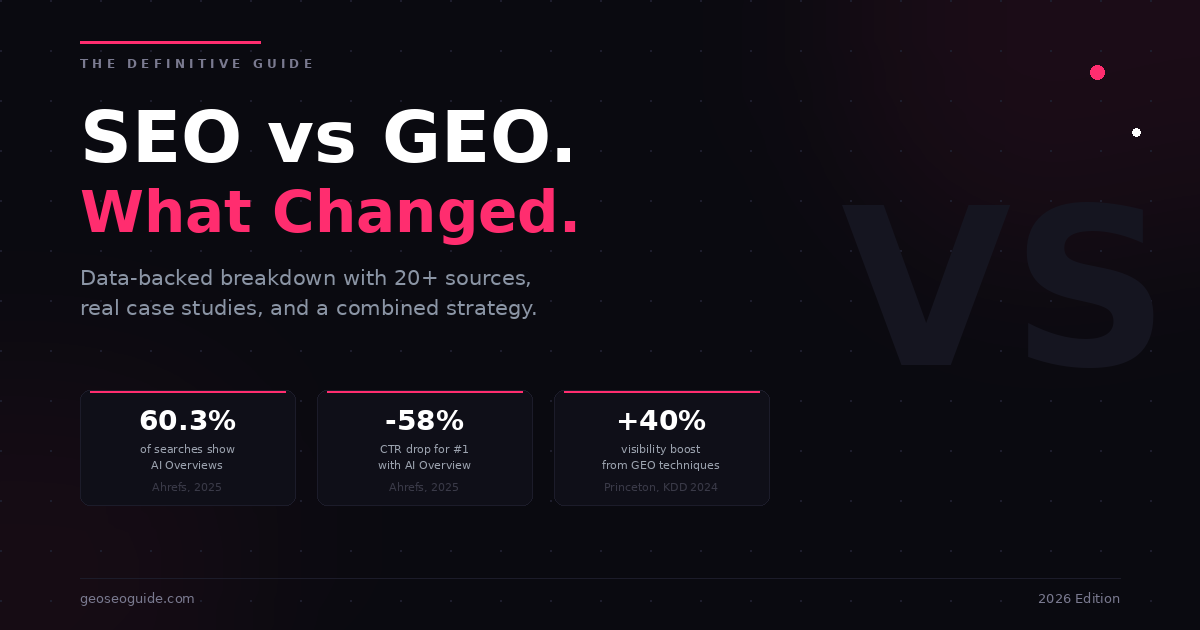
According to Ahrefs’ December 2025 study, AI Overviews now appear on 60.3% of US Google searches. When an AI Overview sits above the organic results, the click-through rate for the number one position drops by 58%. That’s not a minor dip. That’s a structural shift in how people interact with search results.
The numbers get even more stark on mobile. According to Seer Interactive research, 58.5% of Google searches in the US already end without a click, and that figure rises to 75% on mobile devices. Users are getting their answers without ever visiting a website.
Still, SEO remains the foundation. A Semrush study of 304,805 URLs found that 99% of AI Overview citations come from pages already ranking in the organic top 10. Google’s AI isn’t pulling from obscure corners of the internet. It’s pulling from the pages that traditional SEO helped get there in the first place.
So here’s the punchline: SEO isn’t dying. But it’s no longer sufficient on its own.
What Is GEO and Why Should You Actually Care?
Generative Engine Optimization is the practice of structuring your content and digital presence so that AI platforms — ChatGPT, Google AI Overviews, Perplexity, Claude, Gemini — cite, recommend, or mention your brand when users ask questions.
The term was formally introduced in a 2024 research paper by Princeton University, Georgia Tech, and IIT Delhi, presented at KDD 2024 (one of the most prestigious conferences in data science). The researchers tested nine specific optimization techniques and found that methods like adding statistics, citing sources, and including quotations improved visibility in AI-generated responses by up to 40%.
That’s not marketing hype. That’s peer-reviewed research from three major universities.
And the real-world adoption numbers are staggering. ChatGPT now reaches over 800 million weekly active users and processes around 2.5 billion prompts daily. Perplexity AI surpassed 780 million monthly queries by mid-2025. Google’s Gemini app crossed 750 million monthly users. And an estimated 58% of consumers have already replaced traditional search engines with AI tools for product and service discovery.
People are asking AI for answers instead of scrolling through ten blue links. That’s not a prediction — it’s what’s happening right now, at massive scale.
SEO vs GEO: The Core Differences That Actually Matter
Let’s cut through the noise and look at what fundamentally separates these two disciplines.
How Each One Defines “Winning”
With SEO, you win when your page ranks high on a search engine results page. Position one, position two, maybe a featured snippet. The user sees your link, clicks it, and lands on your website.
With GEO, you win when an AI system cites your brand, pulls your data, or recommends your product inside a generated answer. The user might never visit your website — but they absorb your brand, your expertise, your numbers. Your content becomes part of the answer itself.
This is a fundamentally different game. SEO is about earning a click. GEO is about earning a citation.
What Each Discipline Optimizes For
SEO optimizes for crawlability, keyword relevance, backlinks, page speed, mobile-friendliness, and user experience signals. These factors help search engines decide where to rank your page in a list.
GEO optimizes for something different: can an AI system extract a clean, verifiable, well-structured claim from your content and confidently attribute it to you? This means fact density matters. Source attribution matters. Structural clarity matters. Entity authority across the web matters. The Princeton research team found that traditional SEO tactics like keyword stuffing actually performed poorly in generative contexts. What worked instead was specificity — statistics, cited sources, clear claims, and quotable statements.
Where the Traffic Goes (and How It Converts)
This is where things get really interesting — and where the data tells a nuanced story.
A Seer Interactive case study analyzing real traffic data found that ChatGPT visitors viewed an average of 2.3 pages per session — nearly double the 1.2 pages from organic search. Even more striking, their data showed ChatGPT traffic converting at 15.9%, compared to just 1.76% for Google organic.
Think about that for a second. The people arriving from AI referrals are already further along in their decision-making process. They’ve done their “research” inside the AI conversation. By the time they click through, they’re ready to act.
But there’s a caveat worth understanding. A Search Engine Land analysis of 973 ecommerce sites with $20 billion in combined revenue found that ChatGPT referral traffic was roughly 200 times smaller than Google organic, and ecommerce conversion rates specifically trailed organic search. The volume gap is still enormous, and results vary significantly by industry and business model.
The takeaway isn’t that one channel is better. It’s that they serve different purposes at different stages of the customer journey.
The Ranking Signals Are Different
Here’s something most SEO vs GEO comparisons miss entirely. The signals that drive visibility are fundamentally different across these two worlds. Research from The Digital Bloom analyzing AI citation patterns found that brand search volume — not backlinks — is the strongest predictor of AI citations, with a 0.334 correlation. That’s a dramatic departure from traditional SEO, where backlinks have been the dominant ranking factor for two decades.
What does this mean practically? It means brand-building activities that seemed disconnected from SEO — PR, community building, Reddit participation, getting mentioned in roundups and review sites — now directly impact your AI visibility.
Each AI Platform Plays by Different Rules
One of the biggest mistakes marketers make with GEO is treating all AI platforms the same. They’re not. Not even close.
A Qwairy study of 118,101 AI-generated answers with 669,065 citations across eight major providers found dramatic differences in citation behavior. And Averi’s analysis of 680 million citations confirmed the same pattern: only 11% of domains are cited by both ChatGPT and Perplexity.
Let me break down what each major platform favors.
- #1 source: Wikipedia (7.8%)
- Favors encyclopedic content
- 87% citations match Bing top 10
- 3.2× more mentions than links
- #1 source: Reddit (6.6%)
- Real-time retrieval every query
- 780M monthly queries (May 2025)
- Highest citation diversity score
- Most distributed source mix
- 200+ countries, 40+ languages
- Favors YouTube & multi-modal
- SEO ranking = prerequisite
ChatGPT averages 7.92 citations per answer. Its most-cited source? Wikipedia, at 7.8% of total citations. According to Profound’s citation analysis, ChatGPT favors encyclopedic, factual content and pulls heavily from training data. When web browsing is enabled, 87% of citations match Bing’s top 10 results — not Google’s. Interestingly, ChatGPT mentions brands 3.2 times more often than it actually links to them, which means brand awareness from AI goes far beyond clicks.
Perplexity is a completely different animal. It averages 21.87 citations per answer — nearly three times ChatGPT’s rate. Its top source isn’t Wikipedia; it’s Reddit, at 6.6% of total citations. Every query triggers real-time retrieval, meaning fresh content has a genuine edge.
Google AI Overviews shows the most distributed citation pattern — no single source dominates. But the requirement is clear: you must already rank organically. That Semrush study showed 99% of citations come from the organic top 10. Google AI Overviews also favors YouTube and multi-modal content more than the other platforms.
Real Companies, Real Results: What GEO Looks Like in Practice
Theory is nice. Case studies are better. Here are three real-world examples that illustrate different paths to AI visibility.
Tally.so: When ChatGPT Becomes Your Top Acquisition Channel
Tally, a bootstrapped form builder with an 8-person team, became one of the most cited Generative engine optimization success stories in 2025. According to Qwairy’s analysis, ChatGPT accounts for 10% of all referral traffic to Tally’s site — translating to over 3,000 leads per week. Not visitors. Leads.
Their co-founder Marie Martens told AISEOTracker that the team didn’t see this coming. ChatGPT became their number one referral source in early 2025 after GPT-4o’s rollout with default web browsing. When people asked for simple form builders or alternatives to Google Forms, Tally kept showing up. The company hit $3 million in annual recurring revenue five months ahead of schedule, with AI search driving the steepest part of their growth curve.
They didn’t game the system. They built a genuinely good product, created comprehensive comparison content, and structured their pages in a way that made it easy for AI systems to extract and cite them. Simple, but not easy.
IEEE Spectrum: Proof That Substance Still Wins
IEEE Spectrum, the editorial flagship of the world’s largest technical organization, saw their AI referral traffic double in the first half of 2025. ChatGPT accounts for 94% of their AI referral mix, and they’re seeing consistent month-over-month growth — with AI referrals increasing another 9% from May to June 2025 alone.
How? Deep, expert-driven, long-form content with structured data, clear subheadings, and a question-and-answer format. Their digital innovation director, Erico Guizzo, emphasized that the results validated their commitment to substantive journalism. When ChatGPT needs to cite a source on quantum computing, robotics, or large language models, IEEE Spectrum earns that citation because the content is genuinely authoritative.
No shortcuts. No tricks. Just substance backed by structure.
Vercel: The B2B SaaS Signal
According to data cited in Averi’s 2026 B2B SaaS citation benchmarks report, ChatGPT now refers around 10% of Vercel’s new user signups — up from 4.8% the previous month and just 1% six months before that. The trajectory is exponential, not linear. For B2B SaaS companies, this is a leading indicator of where growth is heading.
Why “SEO vs GEO” Is the Wrong Frame (And What to Think Instead)
Here’s where most articles on this topic get it wrong. They frame SEO and GEO as competing strategies — as if you need to pick one. You don’t.
The data makes this clear. That Semrush study showing 99% of AI Overview citations come from the organic top 10 tells you SEO is a prerequisite for GEO in Google’s ecosystem. You can’t get cited by Google’s AI if you’re not ranking organically first.
But here’s the flip side. Superlines research found that 85% of AI citations across platforms like ChatGPT don’t overlap with Google’s top 10 at all. And MarGen’s 2026 GEO guide confirmed that fewer than 10% of sources cited in ChatGPT, Gemini, and Copilot rank in Google’s top 10 for the same query. So strong SEO alone absolutely doesn’t guarantee you’ll show up when someone asks ChatGPT a question about your industry.
You need both. SEO gets you in front of Google’s AI. GEO gets you in front of everything else.
SEO is the foundation. GEO is the visibility layer. You need both.
85% of AI citations don’t overlap with Google’s top 10 — but 99% of AI Overview citations come FROM the top 10.
Think of it this way: SEO builds the foundation. GEO builds the visibility layer that sits on top. Strip away SEO, and your GEO efforts have nothing to stand on. Ignore GEO, and you’re invisible in the fastest-growing discovery channel in the history of digital marketing.
How to Build a Combined SEO and GEO Strategy (Practical Steps)
Enough theory. Here’s what to actually do — organized into a phased approach that makes sense regardless of your team size or budget.
Phase 1: Nail the SEO Fundamentals
Your content needs to rank organically before most AI systems will consider citing it. That means doing the things that have always worked: thorough keyword research, clean site architecture, fast page speed, mobile optimization, proper internal linking, and genuine backlink building.
Don’t skip this step thinking GEO is a shortcut. It’s not. Every case study I’ve examined — Tally, IEEE Spectrum, Vercel — had strong organic foundations before AI traffic took off.
Phase 2: Layer in GEO Content Optimization
Once you have the SEO foundation, add GEO-specific optimization. The Princeton study identified three techniques with the strongest impact on AI visibility: adding relevant statistics, citing authoritative sources, and including direct quotations from experts.
In practice, this means writing content that includes a specific, citable claim every 150 to 200 words. Not vague statements like “many businesses are adopting AI.” Specific ones like “AI-referred web sessions grew 527% year-over-year in the first half of 2025, according to Previsible’s AI Traffic Report.”
AI systems extract sentences, not paragraphs. Every factual statement should be a complete, self-contained, verifiable claim.
Phase 3: Structure Content for AI Extraction
Answer the primary question in your first 40 to 60 words. Enrich Labs’ research confirms that AI retrieval systems evaluate relevance primarily from the opening content of a page. Bury your answer in paragraph seven and the AI will never find it.
Use clear H2 and H3 headings that mirror conversational queries. Think about how someone would phrase a question to ChatGPT, then make that your subheading. Add structured data markup — FAQ schema, HowTo schema, Organization schema. These help AI crawlers parse and process your content more effectively.
And add a “What changed in [current year]” section to your evergreen articles. As Enrich Labs notes, this signals freshness to both AI systems and human readers — and AI platforms weight recency heavily for time-sensitive queries.
Phase 4: Build Entity Authority Beyond Your Website
AI systems don’t just look at your website. They assess your brand’s presence across the entire web. Mentions on Reddit, reviews on G2 or Trustpilot, Wikipedia references, LinkedIn content, YouTube presence — all of these feed into how AI systems evaluate your credibility.
Conductor’s 2026 AEO/GEO benchmark report analyzed 17 million AI answers and 100 million citations across 13,770 domains. The brands cited most were those with strong authority signals across multiple platforms — not just those with good on-site SEO. Amazon, Mayo Clinic, McKinsey, Adobe — these are entities with massive cross-platform presence, and that’s exactly what AI systems reward.
For smaller brands, the playbook is the same at a smaller scale: earn mentions across platforms. Search Engine Land’s GEO overview points out that Reddit, LinkedIn, and YouTube were among the top cited sources by LLMs in late 2025. When your brand creates valuable content on these platforms, you give AI systems more material to draw from.
Phase 5: Optimize by Platform, Not by Assumption
Based on the citation data I outlined above, here’s what platform-specific optimization actually looks like in practice.
For ChatGPT visibility: focus on comprehensive, encyclopedic content. Build or maintain a Wikipedia page if your brand qualifies. Ensure your content is accessible to Bing’s crawler. Invest in press coverage from outlets ChatGPT’s training data includes.
For Perplexity visibility: prioritize Reddit engagement and community content. Publish frequently — Perplexity rewards recency. Create content with multiple cited sources and diverse perspectives.
For Google AI Overviews: traditional SEO is your entry ticket. Add YouTube content. Use structured data markup. Create multi-format content (text + video + infographics) that Google’s multi-modal preferences favor.
Phase 6: Measure Both Channels Separately
Set up regex filters in your analytics to track AI referral traffic distinctly from organic search. Seer Interactive recommends filtering referral sources with a regex pattern matching chatgpt, perplexity, gemini, claude, copilot, and openai. This gives you a clean baseline for monitoring AI traffic separately from organic.
Track citation share (how often AI mentions your brand), citation sentiment (how favorably), and zero-click displacement (traffic lost or gained from AI-generated answers). These are the new KPIs alongside your traditional organic rankings and click-through rates.
Frequently Asked Questions About SEO vs GEO
Does GEO replace SEO?
No. GEO builds on top of SEO. The data is clear: 99% of Google AI Overview citations come from the organic top 10 (Semrush), and every successful GEO case study I’ve examined started with a strong SEO foundation. Think of GEO as an additional optimization layer, not a replacement.
Is GEO just a buzzword?
It’s a formal discipline with peer-reviewed academic research behind it. The Princeton/Georgia Tech/IIT Delhi paper was presented at KDD 2024, one of the most respected conferences in data science. The GEO market is projected to grow from $886 million in 2024 to $7.3 billion by 2031. That’s not buzzword territory.
Which matters more for my business right now?
It depends on your industry. B2B companies are seeing stronger AI referral traffic than B2C (Siege Media). SaaS companies like Tally and Vercel are seeing ChatGPT become a top-three acquisition channel. If your buyers research products by asking AI tools, GEO deserves immediate investment. If your audience is primarily B2C and impulse-driven, SEO still deserves the majority of your budget — but keep a close eye on AI referral trends.
How do I track AI citations of my brand?
Dedicated tools like Qwairy, Profound, and Conductor’s AI module now track brand mentions across ChatGPT, Perplexity, Gemini, and other AI platforms. For a free starting point, set up regex-based analytics filters to isolate AI referral traffic in Google Analytics.
Does AI traffic actually convert?
It depends on the context. Seer Interactive found ChatGPT traffic converting at 15.9% for one B2B site, while a large ecommerce study found AI referrals trailing organic search. The pattern seems consistent: AI traffic converts exceptionally well for considered purchases and B2B decisions, where users have already done their evaluation inside the AI conversation before clicking through.
The Market Is Moving — And the Window Is Closing
Gartner predicts traditional search engine volume will drop 25% by the end of 2026, with AI chatbots and virtual agents capturing that share. The global GEO market was valued at $886 million in 2024 and is projected to reach $7.3 billion by 2031 — an eightfold increase with a 34% compound annual growth rate.
Only 23% of marketers are currently investing in prompt tracking and GEO measurement. That’s a wide-open first-mover opportunity. The Princeton researchers identified a “source preference flywheel” — early visibility breeds more visibility. The brands that get cited first tend to keep getting cited.
By early 2026, most enterprise marketing teams have a GEO initiative. Most small and mid-size businesses haven’t started yet. That gap won’t last forever. AI-driven retail traffic surged 4,700% year-over-year by mid-2025, according to MarGen’s analysis. The trajectory is clear, and the window for gaining a competitive advantage through early GEO adoption is narrowing.
The Bottom Line on SEO vs GEO
The SEO vs GEO debate isn’t really a debate at all. It’s an evolution. SEO taught us to think about what search engines need. GEO teaches us to think about what AI systems need. And increasingly, those needs are converging — but with enough differences that you can’t optimize for one and assume you’ve covered the other.
The businesses that treat these as complementary disciplines — not competing ones — will dominate visibility in 2026 and beyond. The ones that cling exclusively to either approach will find themselves increasingly invisible to the audiences that matter most.
Don’t pick a side. Build both. Start now.
- Ahrefs — AI Overviews CTR Impact Study (Dec 2025)
- Semrush — 304,805 URL Content Optimization Study
- Princeton, Georgia Tech, IIT Delhi — GEO Research Paper (KDD 2024)
- Frase.io — GEO Complete Guide (2026)
- Search Engine Land — GEO Overview
- Seer Interactive — ChatGPT Conversion Case Study
- Search Engine Land — LLM vs Google Conversion Study (973 sites)
- Qwairy — Tally.so GEO Audit
- AISEOTracker — Tally Case Study
- RebelMouse — IEEE Spectrum AI Traffic Study
- Superlines — AI Search Statistics
- Conductor / Search Engine Land — 2026 AEO/GEO Benchmarks
- Incremys — 2026 GEO Statistics
- Enrich Labs — GEO Complete Guide 2026
- Geoptie — Definitive GEO Guide (Gartner prediction)
- The Digital Bloom — 2025 AI Visibility Report
- Qwairy — Provider Citation Behavior Q3 2025
- Averi — B2B SaaS Citation Benchmarks Report 2026
- Profound — AI Platform Citation Patterns
- MarGen — The Definitive Guide to GEO in 2026